
Addressing Grand Challenges through transdisciplinary research collaborations between universities and the arts and cultural sector
Tackling some of society’s biggest challenges requires not only scientific breakthroughs and new technologies, but also artists, museums, theatres and cultural organisations
From climate change and health inequalities to social isolation and the regeneration of struggling communities, many of today’s most pressing problems cannot be solved by technological innovation alone. They also require changes in how people think, behave, connect and participate in society.
Our recently published research in the Journal of Engineering and Technology Management suggests that the arts and cultural sector has an important, but often overlooked, role in addressing these challenges.
Drawing on 90 research impact case studies from UK universities, we found that how universities collaborate with arts and cultural organisations matters for the scale of societal change they can achieve. Collaborations in which cultural partners actively help to develop research are associated with benefits that extend beyond the original project and its immediate participants.
This challenges the conventional view that the arts and cultural sector is primarily active in communicating research findings to the public. Instead, we highlight its potential as an active partner in producing knowledge, developing innovative approaches and creating meaningful societal change.
Why arts and culture matter for society’s biggest challenges
Universities are increasingly expected to demonstrate how their research contributes to addressing major societal challenges, often referred to as Grand Challenges. These include improving health and wellbeing, reducing inequalities, strengthening communities and responding to the climate emergency.
Traditionally, discussions about research and innovation have focused heavily on science, technology and collaboration between universities and businesses. While these partnerships are important, they do not capture the full range of knowledge and expertise needed to address complex societal problems.
Arts and cultural organisations bring distinctive capabilities to research collaborations. Through storytelling, creative practice, performance, exhibitions and community engagement, they can make complex issues more accessible, encourage public participation and create opportunities for people to explore different perspectives.
A theatre performance, for example, may help people engage with difficult health issues. Museums can connect environmental research with local histories and community experiences. Artists can support conversations about neighbourhood identity, regeneration and social inclusion.
Such contributions may not always produce patents, commercial products or technological breakthroughs. Nevertheless, they can generate valuable forms of innovation through new practices, relationships, public engagement and ways of addressing social problems.
These are sometimes described as hidden innovations: important innovations that conventional measures of research and development may overlook.
Our research therefore asked a question: How does the involvement of arts and cultural organisations in university research collaborations contribute to wider societal change?
What we learned from university research collaborations
To investigate this question, we examined 90 impact case studies drawn from the UK's Research Excellence Framework (REF) 2021, which documents how university research makes a difference beyond academia.
We focused on collaborations involving arts and cultural organisations across four major societal challenges: placemaking and levelling up, health and wellbeing, technology for social good, and environment and climate emergency.
The cases included different forms of cultural involvement, ranging from museums and theatres to musicians, artists, galleries and community arts organisations.
One of the most important findings was that cultural organisations do not all participate in research in the same way. We identified three broad roles.
Research users apply findings produced by universities to improve their own activities, services or practices. For example, a cultural organisation might use academic research to inform an exhibition or educational programme.
Resource providers contribute expertise, facilities, networks, venues or other resources that help researchers undertake their work. A museum might provide access to collections, while a theatre might host activities that connect researchers with wider audiences.
Research co-creators participate more directly in developing research, helping to shape questions, design activities, produce knowledge and apply findings. Rather than simply receiving or supporting research, they become active partners in creating it.
These distinctions matter because different forms of participation are associated with different kinds of benefits.
Figure 1. A simplified illustration of the three roles played by arts and cultural organisations and their potential contribution to societal change.
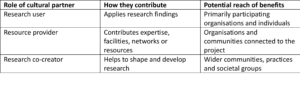
Our analysis found that collaborations involving cultural organisations as resource providers were associated with benefits for organisations and communities directly connected to the research.
More significantly, co-creative collaborations were associated with broader societal change extending beyond the original research project and its immediate partners.
This suggests that cultural organisations can contribute to more far-reaching outcomes when they have opportunities to influence the research process itself.
However, greater participation should not automatically be regarded as better in every situation. The most appropriate form of collaboration depends on what the partners want to achieve. Using research to improve a particular organisation's services can be just as valuable for that purpose as a larger partnership seeking wider social transformation.
Our findings also revealed differences across the four societal challenges. Arts and cultural collaborations addressing health and wellbeing or environmental issues were more likely to report benefits reaching wider societal groups. Projects focused on placemaking or technology for social good more frequently reported benefits for organisations and communities directly connected to the collaboration.
These patterns underline the diversity of ways in which arts and cultural organisations contribute to societal challenges.
What universities, cultural organisations and funders can do differently
Our findings have practical implications for anyone designing, funding or managing research collaborations. First, universities should involve cultural partners earlier in the research process. Rather than inviting a museum, theatre or community arts organisation to communicate findings after a project has been completed, researchers should consider how cultural partners might help identify problems, develop research questions and shape the work from the outset.
Second, partnerships need to recognise the expertise that cultural organisations bring. Their understanding of audiences, communities, creative practices and local contexts can be essential to making research relevant and accessible. This expertise should be valued alongside academic and technical knowledge.
Third, effective collaboration requires time, resources and shared decision-making. Co-creation cannot simply be achieved by describing a partnership as collaborative. Partners need meaningful opportunities to contribute, clearly defined responsibilities and sufficient support to participate throughout the research process.
Fourth, funding bodies should recognise the wider contributions of arts and cultural organisations. Funding programmes often prioritise conventional research outputs or technological innovation. Our findings suggest the importance of also recognising cultural, social and community-based forms of innovation, including the relationships and capabilities that collaborations develop.
Finally, universities and funders should think more carefully about how they assess success. The value of a collaboration should not be measured only through publications, exhibitions or immediate project outcomes. It is also important to consider whether research contributes to changes in organisational practices, community participation, public understanding, policy or wider society.
The broader message is clear: addressing society’s biggest challenges requires us to think beyond traditional boundaries between universities, businesses and communities. Arts and cultural organisations are not simply channels through which academic knowledge reaches the public. They can be active contributors to knowledge creation and innovation, bringing creativity, cultural understanding and community connections into the research process.
If universities, funders and policymakers want research to make a meaningful difference, they need to pay closer attention not only to who is involved in collaboration, but also to how those partners participate.
This blog is based on the open-access article by Federica Rossi, Ning Baines and Evelyn Wilson, “Addressing Grand Challenges through transdisciplinary research collaborations between universities and the arts and cultural sector”, published in the Journal of Engineering and Technology Management.
Image: sourced from Pexels