
Exchanging Knowledge to Protect and Preserve Ukraine’s Cultural Heritage and Museum Sector
Members of the Mentoring Initiative for Museums Steering Group: Maria Blyzinsky (ICOM UK); Alina Kondratiuk (Institute of Historical Research; formerly National Preserve ‘Kyiv-Pechersk Lavra’); Amy Levin (Museum & Society; Northern Illinois University); Elizabeth Savage (Institute of Historical Research)
A new peer-to-peer mentoring initiative involving the Institute of Historical Research (IHR), a sister institute to the NCACE in the University of London’s School for Advanced Study (SAS), connects cultural heritage professionals from Ukraine with experienced mentors in the UK to boost reciprocal skills development, longer-term capacity building, and career advancement. In turn, UK professionals gain deeper knowledge of the Ukrainian cultural heritage environment, insights into the collections they care for, and best practice for disaster preparedness.
In times of war, such exchanges between higher education faculty and cultural heritage professionals become more important than ever. They foster international understanding, encourage collaboration and support peacebuilding. However, possibilities for meaningful exchange are reduced by cultural destruction intended to erase identity, memory and meaning.
The Heritage Sector in Ukraine
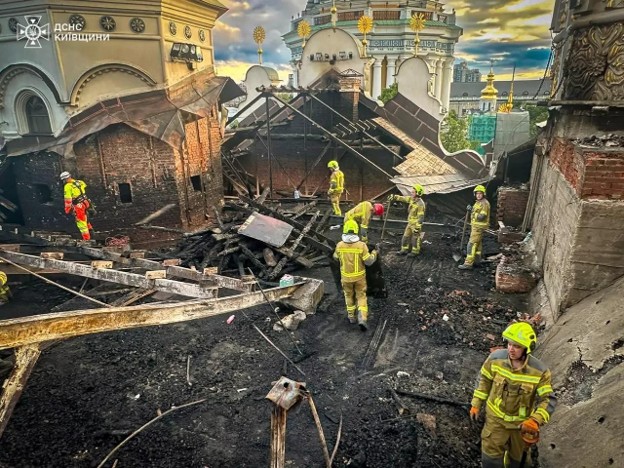
Take, for example, the National Preserve ‘Kyiv-Pechersk Lavra’ in Ukraine, a religious complex founded as a monastery in the 11th century. This complex, now a centre of Eastern Christianity as well as the largest national historical and cultural preserve, was inscribed on the UNESCO World Heritage List in 1990. The irreplaceable site has sustained enormous damage from Russian drone attacks, most recently in June 2026. The adjacent Mystetskyi Arsenal, an 18th-century complex housing a contemporary art centre, was also hit. Staff and clergy have struggled to save artefacts, protect historic structures and maintain a sense of sanctuary. Staff levels are critically low, not least due to conscription, displacement, and forced migration.
The damage to the ‘Kyiv-Pechersk Lavra’ complex is only one example of cultural destruction. Elsewhere, Russia has targeted Ukrainian museum and heritage professionals through direct strikes, power cuts, internet disruptions, and disinformation campaigns. In occupied areas, Russians have engaged in looting, illegal excavations and the erasure of local place names. Ecological damage and land contamination are widespread due to bombing, landmines, fires and flooding.
Clearly, cultural heritage practitioners in Ukraine and the diaspora, as well as their peers in academic museum programmes, can benefit from the cooperation and assistance of mentors elsewhere. Members from the UK’s strong cultural sector with its world-renowned academic programmes relating to museums and heritage are poised to provide support.
Mentoring Initiative for Museums
The new, non-hierarchical Mentoring Initiative for Museums provides Ukrainian museum and heritage professionals as well as scholars with mentoring from UK peers. It will expand possibilities for active knowledge sharing, sustaining embattled professionals’ wellbeing and preserving history. The programme will simultaneously help UK museum and heritage workers to learn more about Ukrainian objects in their collections, as well as about restoration methods developed under current forms of warfare. An institutional twinning option for museums and heritage sites will be added later.
Mentoring Initiative for Museums is a partnership between the UK branch of the NGO Science for Ukraine, which supports the Ukrainian academic community during Russia’s war; ICOM UK and ICOM Ukraine (national committees of the International Council of Museums, a membership association and NGO with over 60,000 members across 139 countries and territories, the only global organisation for museums); and the Institute for Historical Research (IHR), the UK’s national centre for history.
Science for Ukraine supports Ukrainians conducting academic research in all fields. Like the European Research Council, it uses ‘science’ to refer to scholarship in its broadest sense. Its flagship activity in the UK – with generous support from the PushFar mentoring platform – is a well-established academic mentoring and twinning initiative. At the time of writing, Science for Ukraine UK has matched 400 academic mentees from Ukraine and the Ukrainian diaspora with UK-based mentors (with a waiting list of nearly 100 mentees) and 42 twins, or pairs of Ukraine and UK higher education institutions. Some academic mentoring relationships have continued for years and generated substantial research funding, both for the Ukrainian mentee and the UK mentor.
Currently, only two of Science for Ukraine UK’s registered mentors work in museums. The Mentoring Initiative for Museums remedies this situation with a parallel stream of mentoring opportunities in English. It is open to all at-risk, displaced, and refugee museum professionals from Ukraine and the Ukrainian diaspora who have practical or academic expertise in this area. This includes PhD students in appropriate fields; museum educators; curators; conservators; exhibition planners; fundraising and development specialists; and those in related roles at heritage organisations.
Support for the Mentoring Initiative for Museums at SAS
Researchers at the University of London School of Advanced Study (SAS) are leading the way. Dr Alina Kondratiuk, former Head of the Research Department for the Study of Artistic Heritage, National Preserve ‘Kyiv-Pechersk Lavra’, was paired with Dr Elizabeth Savage at the Institute of Historical Research (IHR).
Their experience inspired the creation of the Mentoring Initiative for Museums; both are founding members of the steering group. Their collaboration has led to funding from a learned society in their field, the Bibliographical Society of London, in addition to a UNESCO-backed Leverhulme Visiting Professorship, which will enable Dr Kondratiuk to come to the IHR in 2027 (details to be announced).
This collaboration advances the SAS’s mission to promote and facilitate research, engagement and impact and, by bringing expertise that is not represented in UK academia to the IHR, it will advance the humanities in the UK. At the same time, the partnership will promote a global cultural mission to preserve and protect people and heritage at risk.
Register Now
The Mentoring Initiative for Museums pilot has been launched and will run in the 2026/27 academic year, with registration now open.
Resources:
Mentee registration on the PushFar platform
Mentor registration on the PushFar platform
Booklet about the Mentoring Initiative for Museums
ICOM UK article about the launch of MIM
Policy implications of MIM (History & Policy blog entry)
Science for Ukraine UK’s academic mentoring programmes
Image: Dormition Cathedral of ‘Kyiv-Pechersk Lavra’ after a Russian drone strike during an attack by missiles and drones on the night of 15 June 2026. Five people died and at least 30 were injured in Kyiv.
State Emergency Service of Ukraine, Dsns.gov.ua, CC BY 4.0, via Wikimedia Commons: https://commons.wikimedia.org/wiki/File:Dormition_Cathedral,_Kyiv_Pechersk_Lavra_following_attack_15.webp#S.
