
Music and Parkinson’s: A Collaborative Approach to Making New Music
This blog outlines a collaborative project I led during my time as Head of Enterprise (Academic) at the Royal Northern College of Music (RNCM), designed to expand how music can support people living with Parkinson’s in their daily lives - whether to aid movement, lift mood, or encourage relaxation. Staff and student composers at the RNCM worked with researchers and individuals with Parkinson’s to create new, bespoke pieces of music, crafted both with them and for them.
Over 150,000 people in the UK live with Parkinson’s, now recognised by Parkinson’s UK as the fastest‑growing neurological condition in the world. At the RNCM, my colleagues and I explored the role music plays in the everyday lives, mobility, and wellbeing of people living with Parkinson’s. The Music and Parkinson’s project resulted in seven new pieces of music for solo piano designed to represent and be useful in people’s lives. The project demonstrated how creative partnership can open new pathways for expression, agency, and connection, while deepening our understanding of music’s therapeutic and social value for those affected by Parkinson’s.
Identifying and Recognising the Issue Together
The issue that this project sought to address was that, despite strong evidence that music is useful in the lives of people with Parkinson’s, there is still a lack of recognition of people’s individual differences in how they use music, and their taste in music, and a lack of music specifically designed to be beneficial to this group of listeners. This catalyst for the project was three-fold:
Ours and others’ research on music and Parkinson’s suggests that people with Parkinson’s are often advised to use music to help with symptoms such as gait and freezing (e.g., Dolly Parton’s 9 to 5), but the music proposed may not fit in line with their music preferences (e.g., they may prefer classical to popular music).
Research is now beginning to recognise the importance of working with participants as co-researchers, involved in the creation of new knowledge alongside all other members of a research team (rather than being passive participants in the study only).
Artists and students often seek ways to use their knowledge and skills to improve lives, and thus this project provided a valuable and stimulating opportunity for RNCM staff and student composers to do just that.
The project received funding from the RNCM Principal’s Circle fund and ran for 6 months. The idea grew out of discussions between the stakeholders who all shared a vision to enable music to play a broader and more useful role in the lives of people living with Parkinson’s.
Collaborative Working
There were five groups of people involved in the project: researchers, composers, people with Parkinson’s, people involved in organising the final concert, and audience members. For the researchers, this was a chance to further scholarly knowledge about the role of music in people’s lives if they are living with Parkinson’s. People with Parkinson’s had a chance to contribute their experiences and musical ideas to create outputs which may hopefully be useful for other people with Parkinson’s to listen to in future. Those involved in preparing and performing in the concert had the chance to learn more about Parkinson’s, and in the context of a conservatoire, how music students may be taught and encouraged to use their music to benefit this group. Finally, audience members had the chance to hear seven new pieces of music, in a free, relaxed professional concert, and to learn about Parkinson’s.
How it Began…
The project began with a workshop led by music and Parkinson’s researchers Professor Michelle Phillips (previously RNCM, now University of Manchester) and Professor Ellen Poliakoff (University of Manchester), bringing together people living with Parkinson’s (along with any friends, family members, or supporters who joined them) and RNCM student and staff composers. Held at the RNCM, the workshop offered a two‑hour session (with plenty of tea and cake!) for individuals with Parkinson’s who had taken part in our previous research, alongside RNCM composers. Its purpose was to share insights from existing research and to exchange lived experiences of Parkinson’s, creating a foundation of shared understanding for the creative work that followed.
After hearing about the latest research findings and people’s experiences of living with Parkinson’s, composers were invited to take part in a six‑month project in which they would work with one or more individuals with Parkinson’s to co‑create a new piece of music. Seven RNCM composers volunteered, ranging from first‑year undergraduates to PhD students and staff (professional composers), alongside ten people living with Parkinson’s.
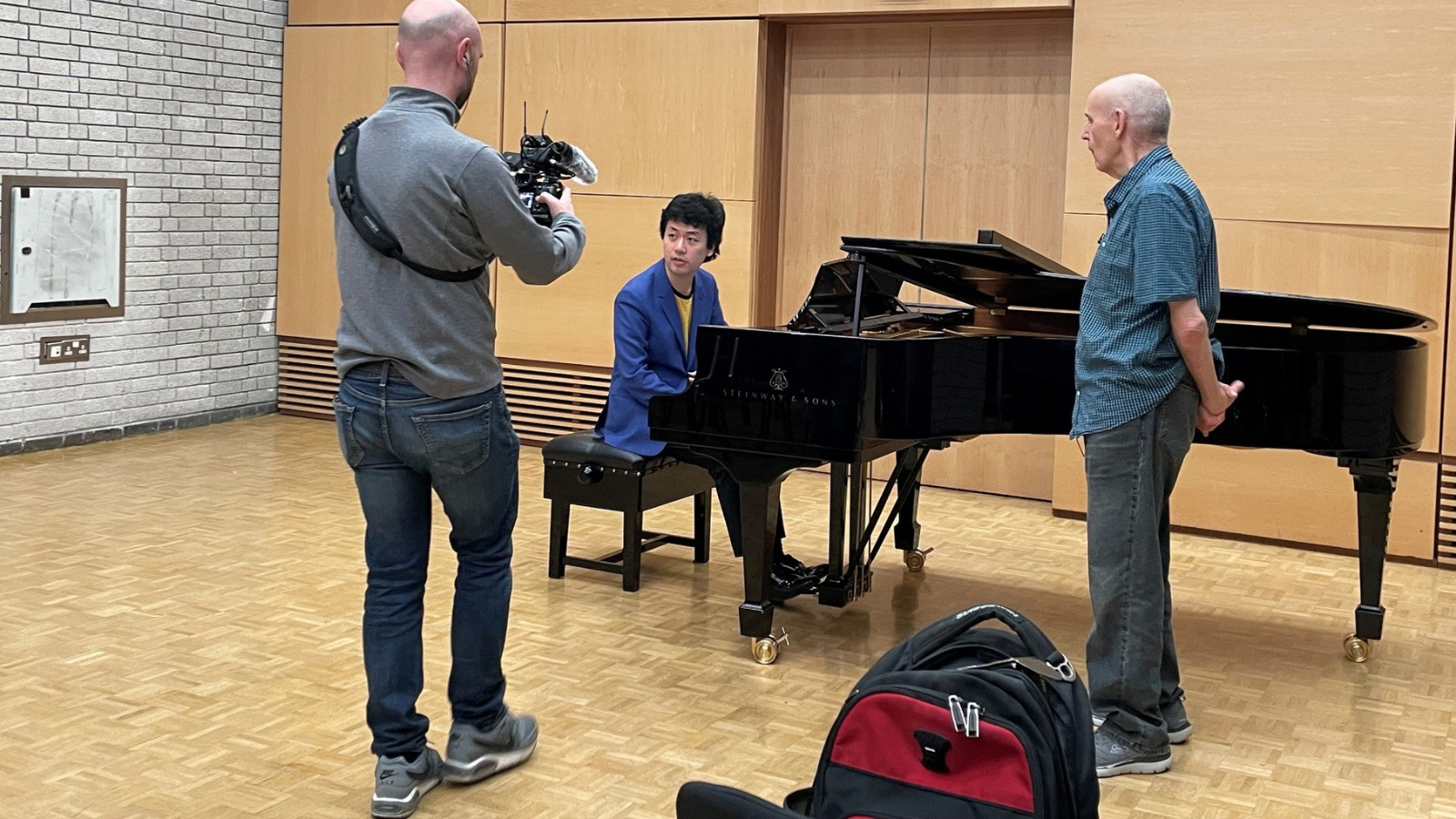
Each partnership decided for themselves how they wanted to work, whether through video calls, in‑person meetings, or, in one case, a series of workshops that led to the creation of a graphic score. The resulting pieces were premiered by RNCM pianist Yuanfan Yang in January 2025, in a free relaxed concert at RNCM Carole Nash Recital Hall, that played to a full house. The new compositions attracted coverage from local press and broadcast media, including a feature on BBC North West Tonight and an interview on BBC Radio 3.
People’s Reflections
Feedback was captured in two ways. Firstly, following the performances we conducted an evaluation of participants’ experiences by inviting everyone involved to take part in semi‑structured interviews. Secondly, the research team is now analysing these interview data and preparing the findings for publication in a creative health journal. Furthermore, we recorded informal feedback from participants with Parkinson’s via email. These reflections, shared voluntarily throughout the project, offered additional insight into their personal experiences of the performances and the wider creative process.
Here are some of the responses from the participants involved:
“The concert was stunning and the music was awesome. I too became very emotional. I don't think that I was prepared for the way the music (Our Piece) invaded my body and mind. It so affected me that it robbed me of my voice. [The composer partner] is such a star and her music summed me up perfectly.... layer upon layer of ecstasy. I will never forget that evening and I can't wait to get my copy off it.”
“I am so grateful to you both for this exceptional experience. […] I must admit, I found that some of the pieces quite a difficult listen. For me they externalized the tumultuous times of my Parkinson's brain and the discordancy with an uncooperative body. [The composer partner] understood that I needed to feel estranged from inner struggles when listening to music and that I needed to reconciliate my brain with form, shape, harmony, leaving behind any frustration and conflict for a few minutes at least. My brief to him was to avoid discordant notes to achieve a sense of peace. And that [The composer partner] did. You can hear it in his composition, the initial notes eliciting my need for calm, relief. The following notes then slowly encouraging my body to feel lighter, to take flight, to move and be the me I am inside.”
“I can't help but being incredibly moved by DANCING LIKE NO ONE'S WATCHING and yes, it makes me cry but with tears of joy because it makes me feel special, it gently whispers: "You can still". There's nothing as powerful as music.”
“All of the pieces spoke to me in many different ways and resonated with my experience. Could you please pass on my congratulations to everyone involved and thank [The composer partner] for the beautiful oasis in the middle of all the madness. Finally, thank you for involving me in the project.”
How it Ended…
The project achieved a high level of success, with participants consistently reporting that they had both enjoyed and benefitted from the experience. It was, however, a challenging undertaking: coordinating two public facing events and asking individuals who had never met, and who brought very different life experiences, to collaborate intensively over six months to create new musical works. This challenge ultimately became one of the project’s strengths. It enabled participants to learn from one another, build trust, and develop a shared creative language. By the end, everyone involved expressed a desire to continue working in this way. The six‑month period of co‑creation proved transformative. Notably, an unanticipated outcome was the enthusiasm across all stakeholder groups to repeat the project and to explore more ambitious musical forms, including larger ensemble compositions and new genres.
What’s Next?
The research team is now undertaking a detailed analysis of the interview data emerging from this project, which will form the basis of a forthcoming publication. At the same time, we are preparing a grant application to extend this work by exploring how and why music may support people living with Parkinson’s (this will be submitted by the University of Manchester, as Michelle has now moved institutions).
The next phase will involve presenting the seven new compositions in a controlled laboratory setting to evaluate participants’ behavioural, neurological, and physiological responses. In parallel, the team is developing a knowledge exchange event at the RNCM, bringing together researchers, knowledge exchange specialists, people with Parkinson’s, industry professionals, composers, performers, and students from both the UK and Switzerland to share insights and explore opportunities for future collaborative projects (see the ‘Playlist for Parkinson’s’ website for more information: Home | Playlist4Parkinsons).
For me personally, this project has enabled me to grow as a researcher and as a human in the world. I am grateful every day to have the chance to be involved in research that is so stimulating, needed, impactful and allows me to work with fantastic people with a variety of perspectives, expertise, and backgrounds.
Further Information
Music and Parkinson’s - Royal Northern College of Music
Research Articles
- Phillips, M., Poliakoff, E., Young, W., and Rose, D., “Music is my Tonic: A qualitative study exploring how people with Parkinson’s use music in everyday life”, Music & Science [submitted]
- Rose, D., Stadelmann, M., Jerjen, R., Köchli, S., Senn, O., Baldassarre, A., Poliakoff, E., & Phillips, M. (2025). The Use of Music Among Swiss People with Parkinson’s: A Mixed Methods Survey and Comparison to the UK Findings. Music & Science, 8.
- Poliakoff, E., Young, W., Phillips, M., Bek, J., and Rose, D. (2023), Vividness and use of imagery related to music and movement in people with Parkinson’s: a mixed-methods survey, Music & Science, 6
- Rose, D., Poliakoff, E., Young, W., and Phillips, M. (2023), The use of music for mood and movement management among people with Parkinson’s: A mixed-methods, Music & Science, 6
- Rose, D., Hadley, R., Guerin, S., Carapellotti, A., Young, W., Phillips, M., and Poliakoff, E. (2023). ‘Levelling the playing field: the role of workshops for to explore how people with Parkinson’s use music for mood and movement management as part of a patient and public involvement strategy’, Frontiers in Rehabilitation Special Issue: Patient and Public involvement in Disability and Rehabilitation Research.
Top image credit: Michelle Phillips. Caption: BBC filming footage