
Introduction
NCACE’s Evidence Café series has been an important and ongoing part of our work since March 2021. They are online events that support presentations, showcasing knowledge and evidence, information sharing, and storytelling. They act as a community for knowledge sharing and exchange in and around the theme of cultural knowledge exchange. Over the last four years, we have curated Evidence Cafes on topics including: Impact and REF, Place-making, Climate Emergency, Health and Wellbeing, the Knowledge Exchange Framework, Universities working with Local authorities on culture related projects, amongst other themes.
Our 15th edition took place in early October, with a focus on Collaborative Research Between Universities and Cultural Institutions: Achieving Transformative Impact. The event, held in partnership with our colleagues at the Centre for Innovation Management in Research (CIMR) at Birkbeck University of London, created an opportunity for the presentation of preliminary findings from research on this theme currently being undertaken by Dr Ning Baines from University of Leicester and Dr Federica Rossi from University of Modena and Co-Director of CIMR at University of Birkbeck.
In this blog, we highlight some of the questions that Ailsa Roberts (National Galleries of Scotland), Joanna Norman (V&A) and Sarah Campbell (Arts and Culture, University of Exeter) spoke with Evelyn Wilson (NCACE) about during our panel discussion.
Cross-sector collaboration - transformations, values and policy recommendations
The objective was to encourage a conversation about the transformative impacts that occur as a result of collaborations between universities and cultural institutions, recognising that the affects can often be surprisingly far-reaching, serving communities beyond the institutions themselves in diverse and positive ways. We spoke about how collaborations occur and the transformations they might bring forth. We also explored the idea of values within collaborations and then talked about what sorts of shifts in the policy and funding landscapes might be necessary to enable the full potential of transformational impact to be realised.
Transformations
1. Can you give us a couple of examples of collaborations that your or your institution have led or co-developed and how they may have shifted the perspective on what collaborative working can achieve?
Ailsa
We collaborate and partner with University and GLAM sector colleagues extensively as well as colleagues in the charity and third sector. One of the projects which has had a great impact for both the participants and National Galleries of Scotland is an ongoing collaboration with Rowan Alba; a charity operating in Edinburgh that helps people with housing and alcohol addiction issues. We host a Community Art Group which was developed during the COVID-19 pandemic, to support those in our community who have had challenges with alcohol addiction, or may be experiencing alcohol addiction, in expressing and communicating their experiences through the arts. Our gallery is a safe, clean, welcoming central Edinburgh space for people to meet, talk and make art with an artist educator. This group is made up of people who would not necessarily visit our galleries but who have engaged with us and our collections in an incredibly positive way.
Sarah
One of our priorities in Arts and Culture is to support new collaborations between the cultural sector and academia. Sometimes we start with the cultural sector and then make connections into the university, and at other times this process is reversed. Regardless of what comes first, there is a consistent need for a bridging team, staff who understand the pressures and expectations specific to each sector and can help smooth the path to collaboration, holding a third space to create an environment conducive to new ways of working.
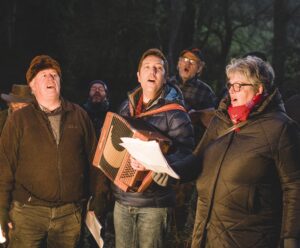
For our Arts Commission in 2020-22, we started with the cultural sector. Working with Lara Goodband, Contemporary Art Curator at the Royal Albert Memorial Museum and Art Gallery (RAMM) in Exeter, we shaped the Commission around RAMM plans for future programming, ensuring alignment with University of Exeter research strengths. This resulted in a very fruitful collaboration with lead artist, Simon Pope, and academic Professor Harry West, Co-Director of the Centre for Rural Policy Research and Lead of Exeter Food Research Network, looking at the microbiopolitics of cider-making, titled Here’s to Thee. Simon brought in six further creative practitioners as fellow collaborators, and the project led to a broad range of outputs, including a display at RAMM in the permanent collection. Working together over a sustained period (including Covid times) was a valuable opportunity to embed process-driven creative practices into the academic working process, identified by colleagues as a major strength of the project.
For our Creative Fellowships, the process is reversed – we start with an internal application process to identify ‘hosts’ in the University – those who are interested in mutually beneficial dialogue and exchange without an expectation of an output – and then work with them to create an artist brief and callout. The selected Creative Fellow then spends 4-5 weeks, over a period that can span 6-8 months, spending time with their ‘hosts’ and exploring ideas together. We deliver 1-3 Creative Fellowships each year, and it is one of my favourite programmes. When the alchemy between host and fellow is successful, they find ways to continue working together; often this programme has acted as seed funding, leading to substantial funded initiatives, either in an arts or research environment.
Jo
Collaboration is a core part of much of the V&A’s work and takes many different forms across our sites and programmes. Among other research collaborations, the V&A has over 40 years of experience of co-teaching the V&A/RCA History of Design Programme at MA and PhD level. The whole programme is designed and delivered on a 50:50 basis between the two institutions, which gives students an incredibly rich experience of being embedded within both an HEI and a national museum but also means that students have the opportunity to contribute to museum projects. At PhD level, we’ve been co-supervising collaborative doctorates for nearly 20 years, with many different HEIs, on projects that are directly linked to the V&A’s priorities. In both of these contexts, the collaborative frameworks often enable a broader collaboration to develop: for example, we’ve often found that a relationship between the V&A and an HEI that starts with co-supervising a doctoral researcher can often develop into more substantial collaborative research projects.
2. How central would you say that collaboration or partnership working is to the work of your institution. What barriers exist?
Ailsa
In terms of research National Galleries of Scotland is not yet an Independent Research Organisation, meaning that we have to apply collaboratively for funding from UKRI. This though has encouraged us to build strong links with both HEIs and the GLAM sector to leverage funding. We have limited capacity in terms of staff time or finance and this means any collaboration or partnership we enter into needs to be equitable and strategic.
Sarah
The sector is under enormous financial pressure and there are many factors beyond the control of any single institution. Although it is a turbulent period with a lot of change, within the maelstrom, partnerships are becoming even more important. We absolutely must take the opportunity that interdisciplinary working presents to innovate our way out of the troubles we are facing.
Jo
Collaboration is vital, especially at times of constrained resources: we can achieve much more together than we can alone. However, it takes time and effort to build and maintain meaningful, lasting partnerships, and time is often in short supply. There are often very practical barriers, such as the availability of funding, who has access to it, and sometimes challenges in bridging what different partners want and need to get out of a collaboration.
Values
3. How are collaborations transforming the way your organisation values different forms of knowledge (e.g academic, Professional, creative, community)
Ailsa
One of our key strengths is our ongoing ability and interest in engaging with many types of knowledge. We know that knowledge does not sits solely in universities or within single narrow categories, rather it exists in many forms, gained in many ways. We work with knowledge holders from across academia, GLAM, the third sector and our own artists, audiences, and communities.
Sarah
The growing interest in practice research, creative research methods, and non-traditional outputs all signals an important shift in how research is conducted, and the role the cultural sector can play in that change. I think this is incredibly exciting – some of the drivers are internal, from the academics themselves who are keen to work outside of discipline silos, and some of the drivers are external, especially from UKRI and REF, with the increasing emphasis on impact and research culture. Initiatives such as Civic University Agreements are also strengthening public engagement with research partnerships, ensuring a flow of ideas between communities inside and outside HE.
Jo
The V&A is inherently interdisciplinary: the breadth and diversity of our collections, practices, sites and audiences mean that different and complementary forms of knowledge co-exist both within the organisation and through our partnerships. We can see examples of successful collaborations, in which different forms of knowledge and expertise come together to create something that wouldn’t otherwise be possible, in a wide range of areas. For example, our conservation and environmental policies are informed by our research collaborations with scientists and engineers; and we and our audiences learn through our collaborations with creative practitioners, who ask their own questions of the museum and its collections, and create new knowledge through their practice. Many of our exhibition and gallery projects are created through collaborative processes, such as Young V&A, which opened in 2023 following a major transformation of the former V&A Museum of Childhood in Bethnal Green, and which was developed for and with children and young people.
4. What values (e.g., equity, creativity, accessibility, respect) are central to truly transformative collaborations?
Ailsa
All collaborations and partnerships with us must link to our strategic aims and objectives, not just those of the collaborator or partner. We expect our knowledge and experience to be treated with respect and for collaborative projects or partnerships to be at least equitable. We are interested in universities and GLAM partners contacting us, but we need time to understand your project and decide if we can participate, and again as Sarah says, we need time to build meaningful and beneficial relationships.
Sarah
Time is everything. Authentic working relationships, particularly when working across power hierarchies, require a huge amount of trust and that process can be rushed. Communities notice when university representatives show up, and when they don’t. I have always considered it vital to my role to be part of the arts community here, and to try to make myself helpful where I can. Reciprocity and genuine interest in the priorities of others are key values for me.
Jo
Time is crucial, as is respect for and acknowledgement of the different kinds of knowledge that each partner brings to the table. It’s really important to have open conversations about roles and responsibilities, and about what each partner wants, or needs, to get out of a collaboration, and what they are able to put into it. Relationships are built on trust, and frank discussions at the outset can help to avoid misunderstandings later on.
5. Where can you see evidence of transformation arising from the collaborative work you/your institution is engaged in.
Ailsa
My post was new at NGS when I started seven years ago and there was some research activity, but it tended to be only a small group of colleagues, engaged in more traditional types of research with a limited number of external partners. We are now developing partnerships with universities and organisations we have never worked with before, in areas which have not been research active before and many more of my colleagues now consider themselves to be researchers. We hope to continue developing and gain IRO status, which we will achieve partly through our collaborative relationships.
Sarah
I have seen a lot of change over the last almost-seven years in post. When I joined, my colleague Naome and I had to let people know that Arts and Culture even existed. We are now a team of four professional services staff (3FTE) with three academic directors (with time allocation as part of their substantive roles). We have 7k followers across our social media platforms, and 25% of our website visitors are international. Most importantly, university colleagues and cultural sector professionals now contact us; we often receive several unique requests a week, asking for advice and support to help peers realise their creative ambitions. We have created a suite of online resources to expand our reach. I like to think that we are part of a virtuous circle – the more that we promote and support creative interdisciplinary collaborations, the more people will work in this way, and the higher the profile for this way of working, the more people will contact us.
Jo
In recent years we have definitely seen an increase in the range of collaborations in which we’re involved, and in what those collaborations are enabling. Our PhD programmes (through fully collaborative PhDs and PhD placements) have expanded, both in scale and in disciplinary reach, and our research collaborations are increasingly interdisciplinary, with a strong strand of research activity that is focused on innovation. The development of new V&A sites has brought new collaborations, such as at V&A East, where we are part of the East Bank cultural quarter, co-located with a number of HEIs and other cultural organisations, and where we’ve worked on a number of co-production projects in collaboration with young east Londoners, communities and creatives around some of the major objects now displayed in the new V&A East Storehouse.
Policy recommendations
6. How can we better measure and communicate transformation - beyond standard outputs like publications or exhibitions – to create better awareness at policy levels and amongst funding bodies?
Ailsa
Since I first started working in the sector sixteen years ago, there has been shift in what is recognised as a research output. Exhibitions, websites, films, and practice-based research are now accepted. The introduction of the Collaborative Doctoral Partnerships scheme has also created much better awareness of GLAM research and practice, and the recently established Early career fellowship in cultural and heritage institutions scheme, both hosted by the V&A, is another step forward for research in the GLAM sector.
Sarah
This is coming, groups like Hidden REF are doing a great job in promoting alternatives. I would like to see more specialist support for assessing the merits of creative methodologies in specific funding applications as this can still feel like a hit-or-miss process, depending on the assessors’ prior experience. Inviting funders and policy-makers into the room (workshops, community consultations) is also important – to see the work in progress and to reveal the importance of process-driven practices, It is a shame that many funders only have access to the shiny prosecco-and-canapes bit at the end.
Jo
It’s important to understand the qualitative impacts of transformation as well as the quantitative: for example, what has a collaboration meant for the different participants in terms of wellbeing, sense of belonging, sense of agency, and how do we measure those benefits in a consistent way?
7. If you could change one thing, or make one key recommendation, in the policy and funding system to unlock greater transformative value from collaborations, what would it be?
Ailsa
Application and reporting processes to be proportionate to the amount of funding received; there needs to be more flexibility on who can receive the funding and what for – within parameters, obviously; and like Sarah I think more readily available small pots of funding with rolling deadlines would be very useful for both us and potential partners.
Sarah
That first rung on the ladder can be difficult to reach when relatively small amounts of funding (£2,000) require the completion of lengthy applications forms and a clear pre-existing understanding of the benefits. I would love to see more opportunities for easier-to-access funding (£500) to begin conversations, to invite an artist for a couple of days of meetings and site visits to build confidence and joint ideas without needing to know where it will lead. Simon Sinek is quoted as saying, ‘There’s nothing efficient about innovation’. While needing to remain respectful of tight budgets, I would like to see more space/oxygen given to just trying things out and seeing where it leads.
Jo
Longer-term funding that could enable time to be taken to build a meaningful partnership before immediately launching into delivery mode. More flexible funding, particularly to enable all participants’ involvement to be funded in a similar way. A more open approach to considering the benefits and impacts of process, as well as outputs, and that enables risk to be taken.
Conclusion
The catalyst for this edition of the Evidence Café is new research on Cultural Institutions and Transformational Impact funded by the Society for Research in Higher Education and being undertaken by NCACE Associate Researchers Dr Ning Baines and Dr Federica Rossi. It builds from NCACE’s research report REF 2021: Research Impact and the arts and culture sectors which Federica and Ning both worked on alongside other NCACE staff. We have also written about this new work here.
Authors
Sarah Campbell, Associate Director for Arts and Culture - University of Exeter
Joanna Norman, Director of the V&A Research Institute, National Art Library and Archives - V&A
Ailsa Roberts, Research Manager - National Galleries of Scotland
Evelyn Wilson, Co-Director - NCACE (Chair)
Image: Bill Murray, Jim Causley, and singers from Mariners Away, performing the Halstow Wassail at Halstow Farm, Devon as part of the Here’s to Thee Arts Commission with artist Simon Pope, funded by Arts and Culture University of Exeter and the Royal Albert Memorial Museum and Art Gallery, January 2022. © Steve Haywood.