
With a compass, dancing shoes, no map. Future-based Cultural Knowledge Exchange
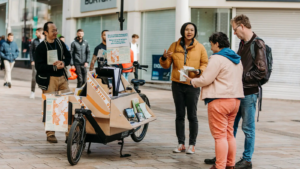
Reflections on the session for the NCACE Festival of Cultural Knowledge Exchange 2026 by Jonathan Edward Bradley
With a compass because when we orientate we find direction and balance. With our dancing shoes because Knowledge Exchange is expressive and fleet of foot and asks for all of our being in the choreography or improvisation of our work. With no map because the world we are part of is so fluid and is responsive to the intuitive and what we bring when we trust in our presence here and now. And the things that happen when we breathe into this kind of space…
As an institution-embedded Knowledge Exchange (KE) professional my role is to enable and realise the inspirations, commitments and visions of our KE actor community - researchers, community and business colleagues, students, other experts. My role, not to stand in the way and shadow. When the work needs to honour the necessity of transactional, operational and procedural, I field the ‘mundanity’ of this and offer the unlocking that gives permission to the ‘adventure’ of collaboration that I hope all of us can feel.
Curating a session for the NCACE Festival of Cultural Knowledge Exchange allowed me to reflect on and articulate my experience of balancing all this necessary implementation work with the equally necessary enquiry into where our KE will be in the future and therefore what we can be, or are doing right now that helps us get there.
My assumption is that our future work is better enabled and therefore more impactful. Maybe with a kinder relationship between mundane and adventure. At the very least we are responding just as effectively and rigorously to whatever the big future challenges will be in their time. Some of the mechanics may be specific to the requirements of the time, but there will also be approaches and principles that thread this future back to what we are building today. With a well-articulated and experiential sense of our desired future we can then do that threading back to the present with intention and care - ‘backcasting’ and ‘roadmapping’. (1)
Right now, many heads are down, bearing weights of focus and intent given to seeming intractable demands. How, with an arts and humanities, creative and cultural perspective do we navigate the contemporary Cultural KE landscape with pressing requirements to deliver to Government Industrial Strategy and the Research Excellence Framework for the universities, and for our creative partners, how to survive as flourishing entities.
The session contributors all have a stake in these missions, all are making novel things happen now, things that will be commonplace tomorrow: Clara Cheung and Rosa Cisneros, both artists, researchers and activists, and Lizzy Craig-Atkins, Neil McSweeney, Wayne Wong, researchers and teachers.
The conversations identified some key characteristics of the future KE landscape that we are building prototypes and solutions for, and are modelling in our practices today.
- Knowledge is no longer centralised, it is distributed and networked: “many commons - each holding a piece, each protecting the whole” Clara Cheung
- In the university and partner relationship, power and responsibility are devolved - with trust. There is no one-size fits all. Co-production is foundational from pre-initiation. Success is measured through how partner priorities are engaged with. When a partner speaks of their value, the value to them, the value they experience, their word is trusted and that value is accounted for. Lizzy Craig-Atkins
- Knowledge Exchange incorporates more than the cerebral. It incorporates our bodies and our soul (or whichever term you prefer to use for this aspect of our being). When tensions arise they are held with care and spoken for with courage. Breath is allowed in the co-production space - there are models for these spaces. Rosa Cisneros
- Tacit as well as explicit forms of knowledge are equally valorised. Intentional design and Intuitive decision-making are balanced. Reputation at scale can be as valuable as resource at scale. Neil McSweeney
- There is a structured ecosystem that stabilizes our networks, enabling more frictionless, complex, and deeply enriched collaborative projects. We have embedded hubs connecting researchers, artists, community organisations, and students. Beyond goodwill, this infrastructure provides dedicated coordination, equitable compensation, and mutual intellectual property frameworks. By aligning administrative systems with collaborative practice, we fundamentally transform our methodologies. Creative partners shift from executing one-off workshops to anchoring long-term co-design; community organisations evolve from participant pools into co-creators of research questions; and students transition from volunteers to active producers. Wayne Wong
In how we are making new things happen we work on the things that shadow our way, we reframe processes, we advocate. On occasions (I confess), we take an "it's better to ask for forgiveness than permission" approach. As well as giving attention to capabilities and capacities, we also develop our own competencies. Shared learning, voice and value are at the centre of our practices.
Value is both the impact that flows from what we do and also the intrinsic value in the actual doing. We are beyond the linear concept of Research, then KE, then Impact. We are experiencing the creation of multiple values in relational ecosystems reliant on, and generating capabilities, capacity and confidence.
And now, the audiences who witness this value and are then asked to enact their responsibilities associated with what they now know. The masters of KEF and REF (2); the authors of University strategies and priorities; the senior implementers of these strategies and priorities; colleagues, academics, professional services and communities of artists, creatives and practitioners, and, oh!, all the people in the world touched however closely or remotely by this work.
- All the people - tell us what you experience when you are actively connected in our work, tell us what you think, what you feel, what you now want to know and do.
- Academics and professional service colleagues, artists, creatives and practitioners - we ask that when you embrace the intuitive in your collaborative relationships you do this as learning and you enable community members to be alongside you and contribute in these learning conversations.
- The authors and the implementers - we ask you to give us fairer payment systems and more nuanced approaches to IP. We ask for stronger recognition that partnership building is part of research practice with long lead ins, involves trust building over time, and benefits from coproduction in advance of funding submission. We ask for both small scale, seed funding and commitment to the long-term in complex relational networks, so long-term relationships don’t have to compete, often unfavourably, with novelty when seeking funding. We ask you to see and therefore recognise and support all the relationship work that is done in complex and powerful ecosystems, that today is so often disvalued because of invisible labour.
- The masters - we ask you to offer us “powerful ways of measuring lived experience, wellbeing, thriving, pride, belonging, without burdening communities to perform in line with preconceived thresholds of proof.” We know, because of the communities of practice (including the NCACE community) we operate in, that this is very achievable.
The clue is in those last words. We know that our desired futures for KE are ‘very achievable’, because of everything people are doing and sharing. With hope, the many forms of our stories, their intentions and aspirations, are giving weight to purposeful change in individual and community practice and in our institution’s priorities and procedures.
As Vanesa van Vlerken says, “Just like the brain can rewire itself to be responsive to novel experience and incorporating knowledge…, so can organisations redesign their processes to be purposefully responsive to change”(3) This rewiring is livened by the flex and fluidity of our dancing practices, orientated with the compass of our values, untied to the constraints of the map. With trust. Everything we need.
Jonathan Edward Bradley is Knowledge Exchange Manager - Arts and Humanities at the University of Sheffield and is also a member of the National Centre for Arts and Cultural Exchange’s Sounding Board.
Clara Cheung is a Sheffield-based Hong Kong artist and activist, co-founder of the C&G Artpartment gallery. Recent projects include Harcourt Road co-led with Bloc Projects. It looks at the histories of community organising on Harcourt Road, a street that exists both in Sheffield and Hong Kong.
Lizzy Craig-Atkins, Professor in Human Osteology at the University of Sheffield, researches heritage policy and practices and leads 'Roots and Futures' - a place-based heritage project that uses creative methods to connect underserved communities with heritage policy and harnesses heritage engagement as a tool to advance social justice, empower communities and improve community cohesion.
Neil McSweeney leads the music industries teaching in the Department of Music at the University of Sheffield. He is also a singer-songwriter and is a co-founder of Hudson Records. In 2025 he launched Harmonic Health Hub, a ground-breaking initiative set to establish Sheffield and South Yorkshire as a global leader in music and well-being innovation.
Rosa Cisneros is a professional dancer, dance historian and critic, a Romani studies scholar, a Flamenco historian, sociologist, curator and peace activist. She is a research-artist at Coventry University’s Centre for Dance Research (C-DaRE) and her work as artist, dancer, curator and researcher is engaged and embedded with Sheffield’s creative and cultural communities.
Wayne Wong, Lecturer in East Asian Studies at the University of Sheffield, is developing new strands of work with artists, curators, filmmakers, and community organisations across the UK. Through film, exhibition, and performance, he explores emerging forms of Hong Kong diasporic identity and the creative possibilities that arise from transnational cultural exchange. His Project Sifu merges martial arts and action filmmaking to empower young people by combining physical training, discipline, and East Asian culture with cinematic storytelling to boost wellbeing and confidence.
Listen to the NCACE Festival session: Future-Based Cultural Knowledge Exchange at the University of Sheffield - 24 April 2026
Photo credit: credit Ai Narapol
____________________________
- Roadmaps are structured representations of the stages leading to your strategic goal or preferred future. Backcasting is a way of connecting a given future to the present and overcoming “present bias” in the way that we plan. It is a tool for determining the steps that need to be taken to deliver a preferred future. Government Office for Science. 2024. The Futures Toolkit. A set of tools to help you develop policies and strategies that are robust in the face of an uncertain future. Available at: Futures toolkit for policymakers and analysts - GOV.UK
- The Knowledge Exchange Framework (KEF) provides a range of information on the knowledge exchange activities of higher education providers in England. Knowledge Exchange Framework. The Research Excellence Framework (REF) is the UK’s system for assessing the quality of research in UK higher education institutions. REF 2029
- Vanesa van Vlerken, Neuroscience Unwrapped