
Archives in Action! Advancing collaboration across the GLAMA sectors
Working with stakeholders to co‑produce research in the archives, galleries, museum, libraries and academic (GLAMA) sectors improves both the quality and impact of research. By involving individuals, groups and communities with an interest in the research project at the start of the journey, we can include a diversity of ideas, opinions and knowledge, which not only improves the research but can bring about lasting change for wider society. For those working with researchers, co-production offers the opportunity to shape research and make it relevant to them and their communities.
While co-production can take place throughout the life cycle of a research project, where possible, we try to include our partners and stakeholders in identifying and designing our research questions, setting priority outputs and outcomes, governance and oversight of the project, co-delivery of engagement activities, and communication and dissemination of findings.
Equitable partnerships and co-produced research are at the heart of what we do. As part of the recent NCACE Festival of Cultural Knowledge Exchange, the Research Impact, Culture and Engagement Team from The National Archives ran a session introducing participants to a range of case studies from across our organisation which demonstrated equitable partnerships and co-production in action.
Who are we?
The National Archives is a multifaceted organisation. It is the official archive and publisher for the UK Government and for England and Wales; a cultural institution; an Independent Research Organisation (IRO); and the leadership and development body for archives in England and Wales.
The research projects we collaborate on aim to be inclusive, innovative and impactful - leading to real-world change. Below are just a few examples from our current research portfolio.
Back on Track
Back on Track is a multimillion-pound funded project, supported by the National Lottery Heritage Fund, and run by Tilbury on the Thames Trust. The project is part of the community and commercial effort to restore and celebrate the Grade II-listed Tilbury Cruise Terminal, part of which is Tilbury Riverside Station, a former railway station.
At The National Archives, Dr Chloe Lee is supporting local community researchers to use our collection to research the local area and contribute to an exhibition to be hosted at the restored Tilbury Cruise Terminal. The project centres on community-led research, interpretation and learning, using heritage as a tool to support skills development, confidence building and long-term engagement in the local area.
The Material Culture of Wills
The Material Culture of Wills is a Leverhulme Trust-funded project and a collaboration between Exeter University and The National Archives. While c. 1 million of the wills in our collection are digitised and downloadable, most public readers do not have the specialist skills required to be able to read the documents, especially those from earlier periods. Led by Mark Bell, Senior Digital Researcher at The National Archives, the project has worked collaboratively with more than 2,500 volunteers from around the globe. Via the crowdsourcing platform Zooniverse, volunteers triple checked more than 150,000 lines of text that had been generated using Handwritten Text Recognition (HTR).
The collaborative transcription process has increased engagement and broadened the accessibility of our collection while simultaneously upskilling the volunteers taking part. Collaborating with real people means the project was also able to uncover details that may have otherwise gone unnoticed. Now that parts of the collection are searchable by key words, we can highlight personal stories from marginalised groups including global majority voices, women and the LGBTQIA+ community.
Inclusive Communication and Research Outputs
Funded by The National Archive’s Strategic Research Fund, this project is a collaboration co-led by Natalie Brown and Sarah Petter at The National Archives and PurpleSTARS, an inclusive group of researchers with and without disabilities and differences based at RIX Inclusive Research Centre, University of East London. The project involved two co-designed workshops, held earlier this year, for ten colleagues from across The National Archives. The workshops focused on practical ways to communicate research creatively, including through sensory storytelling, easy-read methods, and how to co-produce outputs for different audiences. Co-researchers from PurpleSTARS drew on their experiences of collaborating with St Fagans National Museum of Welsh History in the design and delivery of the workshop activities.
The learnings from the workshops are now being embedded at The National Archives, for example in including universal design principles in consultations regarding an office redesign, and in plans for developing guidance for embedding inclusive communication in our work.
Want to find out more or get involved?
By combining institutional expertise with community knowledge and lived experience, co‑production leads to more relevant research questions, ethical practice and richer interpretations of collections. It helps build trust and equitable partnerships, particularly with under‑represented communities, and increases the likelihood that research will deliver meaningful outcomes for practice, access and public value.
If you’d like to find out more about our research projects, please visit our website.
You can read more about our Research Vision here, and you can get in touch at research@nationalarchives.gov.uk.
Blog Authors:
Dr Claire Kennan (Head of Research Impact and Engagement)
Dr Mollie Clarke (Research Impact and Engagement Manager)
Amelia Susserott (Research Culture Manager)
Dr Ellen Addis (Research Engagement Officer)
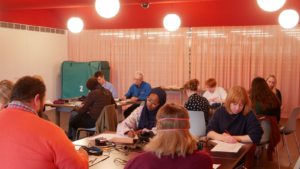
Image Caption: A workshop led by Applied Stories at The National Archives as part of the 2025-26 Research Routes series where attendees worked with archival sound recordings.
Image Credit: The National Archives