

Introduction
In February 2026, NCACE convened researchers, cultural practitioners, and policy specialists for an Evidence Café exploring one of the most urgent questions facing our sector: how can we better understand, measure, and value knowledge exchange (KE) in the arts and culture?
The session formed part of an ongoing collaboration with the Policy Evidence Unit for University Commercialisation and Innovation (UCI) at the University of Cambridge, who are currently undertaking work for Research England to develop the next generation of KE data and metrics. We were also joined by colleagues from the Royal Northern College of Music (RNCM) and the University of the Arts London, who brought valuable institutional perspectives to the discussion.
Dr Phillips gave an overview of the a workshop which this Evidence Café built on, held in September 2025 at the Warburg Institute, co‑hosted by NCACE, UCI, and RNCM. Topics discussed regarding KE in the arts and humanities sector included local regeneration (for example, how cultural interventions attract investment and strengthen community resilience), how to measure KE in progress, audience metrics (including how public engagement activities may support wellbeing, health, and sustainable behaviours), and consultancy offered by the sector (contracted and in kind). The workshop surfaced three guiding questions that continue to shape this work:
- What is the value delivered by university knowledge exchange in the arts and cultural sectors?
- What types of KE should be captured in a modern
- How can we better assess, measure and report the richness of the KE landscape in the arts and humanities and the value it generates?
Together, these questions frame a wider conversation about how arts and humanities KE can be more effectively recognised, supported, and rewarded.
Emerging Findings from UCI: Dr Valeria Ramirez
A highlight of the session was a presentation from Dr Valeria Ramirez, who shared insights on how to create initial findings from UCI’s draft report on KE metrics. She outlined the mixed‑methods approach underpinning the research in the report, which combines:
- collaborative workshops
- a comprehensive literature review
- semi‑structured interviews with a diverse range of respondents
This methodology has helped the UCI team build a nuanced picture of how people describe the value of their KE work, as well as the concerns they hold about current measurement systems.
Drawing on this evidence, Dr Ramirez highlighted several areas that could shape a more contemporary and meaningful KE framework:
- Knowledge exchange domains and pathways that reflect the breadth of activity across the arts and culture
- Enabling infrastructure and professional practice, recognising the systems and expertise that make KE possible
- Communication, visibility, and storytelling as essential KE infrastructure, not peripheral activity
She also addressed the structural challenges the sector faces, including the need for measurement reform beyond single income lines, persistent under‑reporting and legitimacy issues, and the complexity of plural actors and porous work systems.
Ultimately, the emerging framework aims to support good governance, strategic alignment, and clearer boundary‑setting, helping institutions to better understand and invest in their KE ecosystems.
[1] Ramirez, V. (2025). Meaningful Metrics for Knowledge Exchange: Rethinking Social Value Metrics for University-Business and Community Interactions. Policy Evidence Unit for University Commercialisation and Innovation. https://doi.org/10.17863/CAM.121347
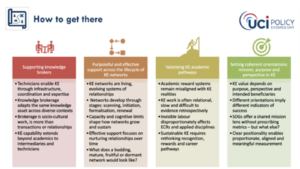
From Cultural Value to KE metrics: Reflections from Dr Patrycja Kąszynska
We were also delighted to welcome Dr Patrycja Kąszynska, who offered a thoughtful reflection on the broader debates surrounding KE metrics and cultural value.
Dr Kąszynska emphasised that while metrics can be useful, they must be approached with caution. This is the lesson learnt in the context of cultural value, that is how the value of art and culture is expressed in the context of decision-making and policy. The value of culture is inherently situated, interpretive, and relational, and its effects often unfold in ways that resist simple quantification. Research repeatedly shows that many existing indicators are weak proxies—metrics that struggle to capture what truly matters in cultural practice or what is significant for society. Importantly, metrics always convey points of view and conceal agendas.
She also noted that multiple, equally valid perspectives on cultural value coexist, often shaped by different priorities. Any attempt to impose a single measurable framework risk flattening these differences and obscuring the richness of cultural work. Dr Kąszynska also cautioned against the risks of over‑measurement. When everything becomes measurable and priced, decision‑making can drift toward narrow technocratic logics, hollowing out the language through which we articulate values and priorities.
Yet, taking the discussion back to KE from the territory of cultural value, disengaging from metrics altogether is not a viable option. As Dr Kąszynska argued, if we do not participate in shaping what is measured, others will do it for us—and often less well. The challenge is therefore pragmatic: to develop indicators that “cut corners less badly,” remaining anchored in qualitative knowledge and contextual interpretation.
Her guiding principle was clear: If we must rely on numbers, let them be meaningful. Metrics only acquire significance when embedded within a broader interpretive framework; detached from qualitative understanding, they risk becoming empty indicators.
Community Reflections: Building Consensus Around What Matters
As part of the Evidence Café, participants were invited to reflect on a series of guiding questions designed to move the conversation from broad observations toward more concrete, consensus‑building insights about KE metrics. This was an opportunity for the community to articulate what a national framework must recognise if it is to work for institutions of all sizes, missions, and disciplinary strengths.
The questions explored included:
- What is critical to see in a national framework that measures KE and works for all institutions?
- What possible ways can metrics be developed that better reflect the arts and humanities (particularly within a sector and industry that is Ffacing a number of complex challenges)
- Institutions can speak to their strengths, but what might be the weaknesses? What is the sector not good at in relation to current government priorities, and how can their work be developed?
- What is missing in what current KE metrics capture?
- What are the key concerns and how can we empower the community (for example, via alternative ways of framing the value of art and culture )
- How can we advocate for the recognition and reward of multiple types of value generated by our KE work and our contribution to sustainable development goals?
These prompts generated rich discussion, surfacing a set of shared concerns and aspirations that cut across institutions and roles.
Emerging Themes and Core Messages
Across the contributions, several strong themes emerged—clear signals of what the sector needs from future KE metrics and where current frameworks fall short.
- A national KE framework must be credible, fair, and genuinely usable
Participants emphasised that any national framework must work for the full diversity of institutions—not just those whose KE activity aligns neatly with income‑based indicators. Metrics must reflect relational, cultural, preventative, and ecosystem‑level value, not only monetised outputs.
- Arts and humanities KE strengthens ecosystems, builds capability, and prevents loss
The community stressed that arts and humanities KE generates value in ways that are often long‑term, preventative, and foundational. It builds cultural capability, supports communities, and sustains the conditions in which innovation and resilience can flourish. If metrics fail to capture this, they risk misrepresenting the sector’s contribution.
- The most important contributions can be the least visible
Cultural value, relational work, public meaning‑making, and long‑term ecosystem support are central to arts and humanities KE—but they remain largely invisible in current policy frameworks and the hierarchy of evidence, skewed as it is, towards evidencing the tangibles. Institutions often lack the infrastructure, capacity, or language to evidence these forms of value at scale.
- Current metrics miss what matters most
Participants noted that the value created by arts, humanities, and place‑based cultural ecosystems is widely felt but poorly translated into the languages used by policymakers, funders, and senior institutional leaders. This mismatch creates a persistent legitimacy gap. In order to overcome it, more translation is needed between how the KE community understands value and how policymakers speak (it cannot be just a one-way-traffic).
- A shift toward balanced, purpose‑driven reporting
There was strong appetite for moving beyond narrow, income‑dominated reporting toward a balanced account of economic, social, cultural, and environmental value (amongst many other kinds of value, for example, value in terms of health and wellbeing). Participants called for metrics that reflect the full spectrum of KE contributions, aligned with broader societal goals.
- Recognition and reward must extend beyond institutional incentives
The community expressed a desire to move beyond frameworks that reward institutions alone. Instead, they advocated for a broader shift in how value is understood, evidenced, and legitimised across the entire KE ecosystem—including communities, cultural partners, and civic collaborators. This breaking of institutional silos is challenging in the current climate that encourages zero-sum-game competition but will ultimately result in making the system stronger.
- Arts and humanities KE is foundational, not peripheral
A powerful message emerged: arts and humanities KE is not a “nice to have.” Many institutions engage in KE as their core business – for example, students perform new interpretations of music, dance and drama works to general public audiences weekly, and public institutional galleries showcase student artwork. KE in the arts and humantities builds capability, strengthens communities, enables innovation, and creates the cultural conditions for economic and environmental resilience. It is central to wellbeing, sustainable development, and inclusive growth.
Looking Ahead
The February Evidence Café offered a vital space for dialogue, reflection, and co‑creation. It allowed participants to engage directly with emerging findings, test ideas, and contribute to the shaping of a more meaningful and equitable KE framework for the arts and cultural sectors.
As UCI’s work develop, the insights shared during the session will play an important role in refining recommendations and ensuring that future KE metrics reflect the full breadth and complexity of cultural practice.
NCACE remains committed to supporting this work—by convening conversations, amplifying sector voices, and championing the value of arts‑based knowledge exchange in all its forms.