
Most who are reading NCACE blogs will, I think, be broadly pleased that the creative industries are now regarded by government - in last year's Industrial Strategy but also in several subsequent policy statements - as one of the main drivers of future economic growth. The government now seems to believe that the creative industries sector can grow faster than the economy as a whole and make a significant contribution to national wealth and employment over the next decade and beyond. There is particular emphasis - as we'll see - on businesses that combine creativity with technology, generate valuable intellectual property, and adopt emerging tools such as artificial intelligence and immersive technologies to develop new products and services.
Government thinking also places creative enterprise at the heart of regional renewal. By supporting local investment, developing clusters, and linking places through 'creative corridors' government hopes regional growth will follow. Internationally, too, the sector is seen as both a strong export performer and an important source of cultural 'soft power' influence. Policy ambitions include making the UK the most attractive destination in the world for creative investment, while expanding trade support, overseas promotion, and access to global markets. Finally, creative industries policy is closely tied to workforce development and inclusion. There's a focus on building clear skills pathways, widening access to diverse talent, and creating new routes for young people to enter sustainable, high-quality creative careers.
All good news. But I am worried, and for one very simple reason.
The government seems to see the creative industries as an extension of - and almost wholly dependent upon - the technology sectors for this bold and bright future. Indeed the government's strategic statements are laced with something more: a suggestion that future creative industry output and value will depend primarily not on creativity, invention, genius, insight into our world and our human condition but, simply, R&D in creative technology. The Creative Industries Sector Plan (June 2025) says 'We will harness the power of creators, entrepreneurs and investors, and establish the UK as a global leader in the emerging ‘createch’ sector. We will embrace new technologies to drive intellectual property (IP) creation, maximising its value in the age of AI while protecting and incentivising human creativity.' (Note, by the way, the order in that first sentence: creators will be harnessed to grow tech, not the other way around).
The Creative Industries Minister, Ian Murray, said in Liverpool in January that 'As part of a record settlement of research and development funding over the next three years and beyond, we are going to help artists, entrepreneurs and businesses up and down the country to innovate with new technologies, attract investment and nurture talent', implying that, but for technology, the creativity in Britons alone would barely raise interest. One even suspects that the renaming of the DCMS Creative Futures to the Createch Futures programme was anything but a minor edit, but instead seeks to end any suspicion that creativity itself is an asset in need of a future.
Now createch is important. AI, extended reality (XR), immersive audio, hologram rendering may all play a part in shaping how creative art is experienced. Distributed ledger technologies, stablecoins and smart wallets may alter how it is consumed and even owned. All - and more than these few - can play a role in opening creative experiences to wider and newer audiences. The government's Business.gov website proudly announces that createch is 'Forecasted to generate £18 billion in GVA and create 160,000 jobs over the next decade [and] to grow ten times faster than the wider creative industries.'
Here, though, is the problem. In the same way that the mobile phone would never have been a leading technology of the late 20th century if people had nothing to say to each other, createch can't grow unless creative practice and the insight into the human condition that fuels it continues to evolve and to change. VR experiences based on narratives that aren't new too are just a gimmick. Immersive experiences that use extant art or extant soundscapes are nice but are going sooner or later to run into that great enemy of the creative sector, boredom.
So rather than celebrating the assumption that createch will 'grow ten times faster than the wider creative industries' I'd like us all to pause and wonder where creativity itself will come from in this pioneering tech-fuelled future. In universities arts and humanities courses have been retrenched, and apprenticeships remain low in subjects related to the arts. Life as a creative outside of industry roles (in sectors like advertising, for example) remain as precarious as it was in the 19th century. Where will that essential asset of the creative industries, creativity itself, come from.
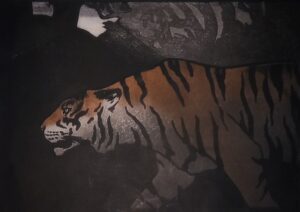
Whether we're in universities, in the arts or (like me) in neither, we need to remind our politicians and ourselves that the creative ideas and creative practices needed to make this great future forecast in the sector strategy won't just happen - indeed if creativity itself withers in Britain there simply won't be enough creative imagination to go around. We should argue for more creative expression in schools, in workplaces, in leisure and in the working day. More invention of the kind that led Matisse to experiment with cut-outs, Schoenberg to experiment with atonality, or (as above) for John Dixon Batten to add texture, shimmer and surface sheen to the humble coloured woodcut, a print form we all thought we knew. More creativity, and creativity being a more common theme of our lives and experiences in the UK, will have the happy effect also of reducing the 'shock of the new'. Instead, we'll see the novel and creative as an expected feature of our world, as a ‘predictable unpredictable force’ that is essential to our lives.
We need a national conversation about harnessing a renewal of creativity for us - not just for tech.
Image: Woodcut print titled The Tiger by John Dickson Batten, 1900.